

Quick answer: A monofocal IOL gives sharp vision at one distance (usually far), an EDOF (extended depth of focus) IOL stretches clear vision from far to intermediate with fewer halos than most multifocals, and a multifocal IOL aims to cover far, intermediate, and near but carries a higher chance of glare or halos. The best choice depends on your eye health, visual priorities, and tolerance for trade-offs.
If you live in Juyeop or elsewhere in Ilsan and are preparing for cataract surgery, choosing an intraocular lens (IOL) can feel like the hardest decision. The surgery removes the cloudy natural lens, but the artificial lens you choose shapes how you see for the rest of your life. This guide compares the main IOL types in plain language and summarizes recent lens news.
What Is an Intraocular Lens?
An intraocular lens is a small, clear artificial lens placed inside the eye during cataract surgery, usually in the same capsular bag that held the natural lens. IOLs are designed to last a lifetime. Before surgery, precise measurements (biometry) determine the lens power needed.
The Three Main IOL Categories
1. Monofocal IOLs
A monofocal lens focuses at a single distance. Most people choose distance focus and use reading glasses for near tasks.
- Strengths: excellent contrast and image quality, lowest risk of halos and glare, suitable for most eyes, including those with retinal or optic-nerve disease.
- Limitations: glasses are usually needed for reading and often for computer work.
- Enhanced monofocals: some newer monofocal designs, such as TECNIS Eyhance, slightly extend intermediate vision while keeping monofocal-like visual quality.
- Monovision option: one eye set for distance and the other for near can reduce dependence on glasses for some people, but depth perception may be affected.
2. EDOF (Extended Depth of Focus) IOLs
EDOF lenses create an elongated focal range rather than separate focal points. They typically provide good distance and intermediate vision (dashboard, computer, cooking) and functional near vision for some tasks.
- Strengths: broader range than monofocals, generally fewer visual disturbances than diffractive multifocals.
- Limitations: fine print or small phone text may still require reading glasses; mild halos are possible.
- Examples: non-diffractive designs such as AcrySof IQ Vivity and TECNIS PureSee.
3. Multifocal and Trifocal IOLs
These lenses split light into several focal points to provide distance, intermediate, and near vision.
- Strengths: the highest chance of reduced dependence on glasses across distances.
- Limitations: halos and glare around lights at night are more common, contrast may be slightly lower, and some people need weeks to months to adapt. They may not be suitable for people with macular disease, advanced glaucoma, or irregular corneas.
- Example: trifocal designs such as AcrySof IQ PanOptix.
Toric versions for astigmatism
Most categories are available in toric versions that also correct corneal astigmatism. Precise alignment during surgery is essential for best results.

How to Match a Lens to Your Lifestyle
Ask yourself these questions before your consultation:
- What do you spend most time doing? Driving, golf, and hiking favor distance; office work and cooking favor intermediate; knitting, reading, and phone use favor near.
- How much do you mind wearing glasses? If reading glasses do not bother you, a monofocal may be ideal.
- Do you drive a lot at night? People sensitive to halos may prefer monofocal or EDOF designs.
- Are you detail-oriented about sharpness? Some people value crisp contrast over range.
- Do you have other eye conditions? Macular degeneration, diabetic retinopathy, glaucoma, dry eye, or prior refractive surgery can narrow your options.
Tests That Guide IOL Selection
Choosing an IOL is not only a preference; it also depends on measurements:
- Optical biometry: axial length and lens power calculation.
- Corneal topography and tomography: astigmatism and corneal regularity.
- OCT of the macula: to detect retinal conditions that may limit premium lenses.
- Tear film assessment: dry eye can distort measurements and should be treated first.
- Pupil size and lifestyle interview.
What Is New in IOLs (2026)?
Lens technology continues to evolve. Recent developments include:
- March 2026: the US FDA approved TECNIS PureSee and PureSee Toric II, an EDOF lens. According to the FDA labeling, it improves intermediate vision compared with an aspheric monofocal while maintaining comparable distance vision. Johnson & Johnson expanded US availability in June 2026.
- April 2026: Alcon launched Clareon TruPlus, an enhanced monofocal and toric design intended to increase depth of focus while maintaining distance quality.
- September 2026: the US FDA approved RayOne Galaxy and Galaxy Toric, a non-diffractive spiral-optic presbyopia-correcting lens from Rayner.
- 2026: Alcon and RxSight announced a collaboration on adjustable presbyopia-correcting lenses, reflecting growing interest in fine-tuning results after surgery.
Please note: FDA approvals are US regulatory decisions. Some lenses have been available in Korea and other markets earlier, while others may not be approved here at all. Lens availability at any clinic changes over time, so ask your surgeon which options are currently offered and suitable for you.
Realistic Expectations
No IOL perfectly recreates the natural focusing ability of a young eye. Every option involves trade-offs between range, sharpness, and night-time visual effects. Glasses may still be needed for certain tasks, and visual results vary between individuals. A thorough pre-operative evaluation and honest conversation with your surgeon are the best ways to choose.
Frequently Asked Questions
What is the difference between EDOF and multifocal lenses?
EDOF lenses extend one continuous focal range, mainly covering distance and intermediate vision, usually with fewer halos. Multifocal and trifocal lenses create separate focal points for distance, intermediate, and near, offering more glasses independence but more potential for glare and halos.
Which IOL causes the fewest halos?
Monofocal lenses generally carry the lowest risk of halos and glare. Non-diffractive EDOF lenses are designed to keep visual disturbances closer to monofocal levels, though some people still notice mild effects.
Can I change my IOL later if I am unhappy?
IOL exchange is possible in some situations but is more complex than the original surgery and carries additional risk. Careful lens selection before surgery is strongly preferred.
Do I still need glasses after cataract surgery with a premium IOL?
Many people need glasses less often, but some still use them for fine print, night driving, or specific tasks. Results vary depending on the lens and your eyes.
Can people with glaucoma or macular degeneration get multifocal IOLs?
Often a monofocal or carefully selected EDOF lens is preferred, because multifocal designs may reduce contrast. Your ophthalmologist will advise based on the severity of your condition.
Key Takeaways
- Monofocal IOLs offer the sharpest single-distance vision with the fewest halos.
- EDOF IOLs extend clear vision from far to intermediate with generally fewer visual disturbances than multifocals.
- Multifocal and trifocal IOLs offer the broadest range but more potential for glare and halos.
- Eye health tests such as biometry, topography, and macular OCT are as important as lifestyle preferences.
- 2026 brought US approvals of TECNIS PureSee and RayOne Galaxy; availability in Korea differs.
Medical disclaimer: This article is provided for general health information and education only. It is not a diagnosis or a substitute for an in-person examination. Suitability of any test or treatment, and its results, differ from person to person, and every procedure carries potential risks and side effects. Please consult an ophthalmologist about your own eyes. Regulatory approvals mentioned (such as US FDA decisions) apply only to the jurisdiction named, and the products discussed may not be approved or available in Korea.
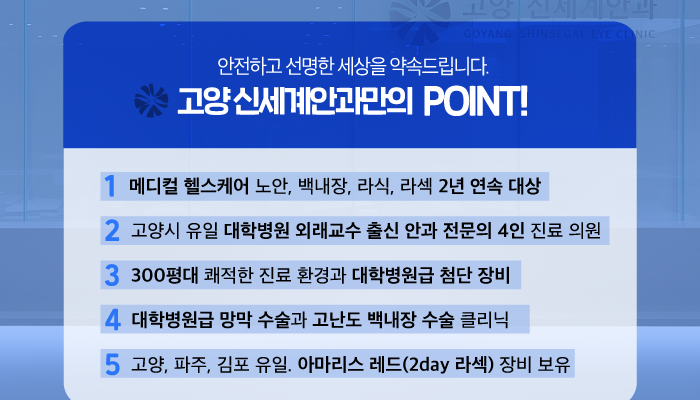
Goyang Shinsegae Eye Clinic (고양신세계안과)
- Address: 6F Haengsin Square, 126 Chungjang-ro, Deogyang-gu, Goyang-si, Gyeonggi-do, Korea
- Phone: 031-8076-9999
- Hours: Mon–Fri 09:00–18:30 · Sat 09:00–14:00 · Lunch 13:00–14:00 · Closed Sundays