
Hello, this is Goyang Shinsegae Eye Clinic.
When symptoms such as stinging, burning, or irritation occur repeatedly, many people naturally suspect dry eye syndrome.
Eye fatigue and blurred vision are also common, especially after prolonged use of smartphones or computers.
Many people assume that these symptoms are simply caused by insufficient tear production.
However, dry eye disease can also develop when tears evaporate too quickly or fail to remain stable on the ocular surface, even when the eyes produce an adequate amount of tears.
Dry eye disease is not merely a problem of insufficient moisture.
Identifying the underlying cause is the first step toward appropriate treatment.
Today, we will explore the different types of dry eye disease and the treatment options available depending on their underlying causes.

1. Dry Eye Disease: Symptoms Can Vary Depending on the Cause
Even when patients have the same condition, the symptoms they experience may differ considerably.
Some people notice that their eyes become particularly tired in the afternoon, while others experience persistent stinging, irritation, or noticeable redness throughout the day.
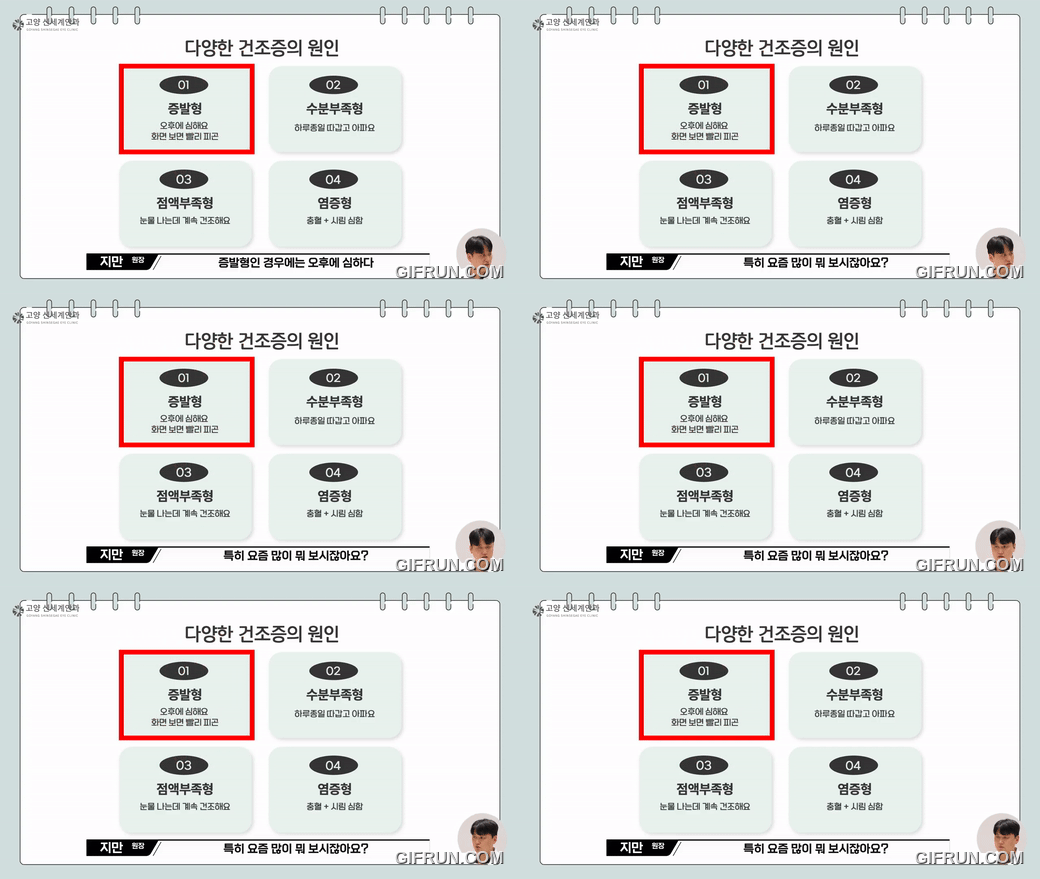
| Main Symptoms | Possible Causes |
|---|---|
| Dryness and discomfort that worsen in the afternoon | Evaporative dry eye |
| Persistent stinging throughout the day | Aqueous-deficient dry eye |
| Excessive tearing accompanied by a foreign-body sensation | Tear film instability |
| Recurrent redness and irritation | Ocular surface inflammation |
These symptoms may provide useful clues about the underlying cause.
However, a comprehensive eye examination is necessary to identify the specific type of dry eye disease accurately.

2. Problems with the Tear Film’s Oil Layer: IPL and LipiFlow
The upper and lower eyelids contain specialized oil-producing glands called the meibomian glands.
The oil secreted by these glands forms a protective lipid layer over the tear film, helping prevent tears from evaporating too quickly.
However, when the oil becomes thickened or the glands become obstructed, the protective layer may become unstable, resulting in dryness and discomfort.
Two commonly considered treatment options for meibomian gland dysfunction are Intense Pulsed Light (IPL) therapy and LipiFlow.
① IPL Therapy
IPL therapy uses intense pulses of light at selected wavelengths.
This treatment may help reduce inflammation around the eyelids and improve meibomian gland function.
It is particularly considered when gland dysfunction is accompanied by inflammatory changes.
② LipiFlow Treatment
LipiFlow is a thermal pulsation treatment that delivers controlled heat to the inner eyelids while applying gentle pressure to the outer eyelids.
This process helps soften thickened oils and encourages their release from the meibomian glands.
As a result, it may help improve gland function and tear film stability.
Although IPL and LipiFlow work through different mechanisms, both aim to address meibomian gland dysfunction.
If symptoms do not improve sufficiently after IPL therapy, LipiFlow may be considered as an additional treatment option.
However, the appropriate treatment should always be determined based on examination findings and the patient’s individual eye condition.

3. Treatment for Aqueous-Deficient Dry Eye: Artificial Tears and Punctal Plugs
Aqueous-deficient dry eye occurs when the lacrimal glands do not produce enough tears to maintain adequate moisture on the ocular surface.
This condition may be associated with disorders that affect tear production, such as Sjögren’s syndrome.
It may also develop after refractive procedures such as LASIK or LASEK.
① Artificial Tears
Artificial tears help supplement the tear film, reduce friction on the ocular surface, and relieve irritation.
They are commonly used to manage symptoms of dry eye disease.
However, artificial tear products differ in their ingredients, viscosity, and formulation.
Therefore, selecting an appropriate product based on symptom severity and ocular surface condition is important.
② Punctal Occlusion
When tear production is significantly reduced, punctal occlusion may be considered.
This treatment involves partially blocking the small openings through which tears normally drain from the eyes.
Simply put, it works by closing the eye’s natural drainage outlets to help tears remain on the ocular surface for a longer period.
One commonly used method involves inserting temporary punctal plugs.
Before recommending this treatment, an ophthalmologist evaluates the amount of tear production and checks for inflammation or other ocular surface conditions.
The decision to proceed depends on the individual patient’s examination results.

4. Mucin Layer Abnormalities and Inflammation Treatment
The ocular surface contains a mucin component that helps tears spread evenly and remain stable across the eye.
When this function becomes impaired, tears may not adhere properly to the ocular surface, even if tear production is sufficient.
In such cases, eye drops designed to promote mucin secretion may be considered to improve tear film stability.
Repeated damage to the ocular surface can also trigger inflammation.
This inflammation may further worsen irritation and disrupt the tear film, creating a cycle of dryness, inflammation, and discomfort.
When inflammation plays a significant role, anti-inflammatory eye drops such as cyclosporine may be prescribed to help regulate the inflammatory response.
However, the type of medication, dosage, and duration of treatment should be determined by an ophthalmologist based on the patient’s clinical condition.

5. Warm Compresses and Eyelid Hygiene: Essential Parts of Dry Eye Management
Managing dry eye disease involves more than treatments performed at an eye clinic.
Daily eye care habits can also play an important role in maintaining tear film stability and reducing discomfort.
In particular, warm compresses and proper eyelid hygiene may be beneficial when the oils produced by the meibomian glands become thickened or obstructed.
Recommended daily care practices include:
- Apply a warm compress at a comfortable, appropriate temperature for approximately 10 to 15 minutes.
- Gently clean the eyelid margins after using a warm compress.
- Make a conscious effort to blink frequently while using smartphones or other digital devices.
- Take regular breaks during prolonged screen use.
When applying a warm compress, it is important to avoid excessively high temperatures that could irritate or burn the delicate eyelid skin.
Strong pressure should also be avoided to prevent unnecessary irritation or injury.
Consistent daily care, combined with appropriate medical treatment when necessary, may help improve comfort and support healthier tear film function.

Q&A: Frequently Asked Questions
Q. Which treatment is better for dry eye disease, IPL or LipiFlow?
A. Neither treatment is necessarily superior in every situation.
IPL and LipiFlow work through different mechanisms, and their suitability depends on the underlying cause of the patient’s symptoms.
An ophthalmologist evaluates factors such as the degree of meibomian gland obstruction, gland function, and the presence of inflammation before recommending an appropriate treatment.
Q. Is using artificial tears alone enough to manage dry eye disease?
A. Artificial tears can help relieve mild dryness and irritation.
However, if the underlying cause involves meibomian gland dysfunction, tear film instability, or ocular surface inflammation, additional treatment may be necessary.
Artificial tears may provide temporary symptom relief without fully addressing the underlying problem.
Understanding the Cause Is the First Step Toward Effective Dry Eye Management
Although dry eye disease often produces similar symptoms, its underlying causes can vary from person to person.
When meibomian gland dysfunction is present, treatments such as IPL or LipiFlow may be considered.
For patients with significantly reduced tear production, artificial tears or punctal occlusion may be appropriate.
If mucin layer abnormalities or ocular surface inflammation are involved, specialized prescription eye drops may be needed.
Therefore, if you repeatedly experience stinging, burning, irritation, or persistent redness, it is advisable to seek an eye examination rather than relying solely on artificial tears.
Understanding your current eye condition and combining appropriate treatment with healthy daily habits are important steps toward maintaining long-term eye health.
Thank you for reading.