Hello,
this is Goyang Shinsegae Eye Clinic.
Around the mid-40s, many people begin to notice that text messages on their smartphones or small print in books are no longer as clear as they used to be.
At first, it may be easy to dismiss these changes as simple eye fatigue.
However, if you need to hold your smartphone farther away than usual to read comfortably, or if it takes longer for your eyes to refocus when looking from a nearby object to something in the distance, presbyopia may be a possible cause.
Recently, more people have been exploring not only reading glasses or corrective eyewear but also surgical options to reduce the inconvenience caused by presbyopia.
However, the appropriate type of presbyopia surgery may vary depending on the current condition of the eyes and whether cataracts are also present.
For this reason, it is important to make a decision based on a thorough eye examination.
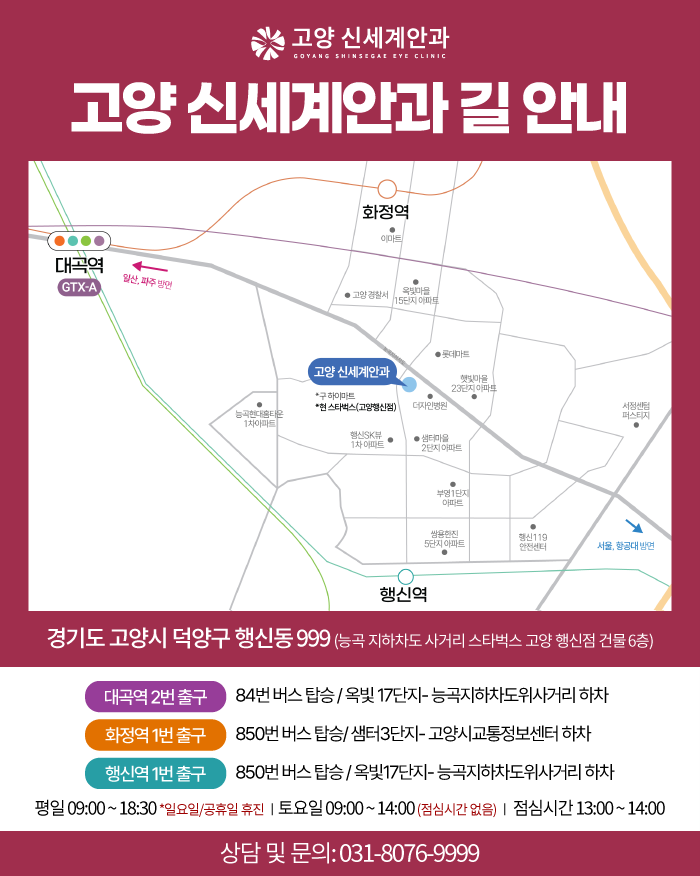

- Why Does Presbyopia Occur?
Presbyopia is an age-related condition in which the eye gradually loses its ability to focus clearly on nearby objects.
The natural lens inside the eye helps adjust the eye’s focusing power when looking at objects at different distances.
When we are younger, the lens is relatively flexible and the focusing mechanism of the eye works efficiently.
As a result, the eyes can quickly adjust when shifting focus between near and distant objects.
However, as we age, the natural lens gradually becomes less flexible, and the eye’s focusing ability begins to decline.
This can make it more difficult to focus on nearby objects, causing small print to appear blurry or leading people to hold books and smartphones farther away in order to see more clearly.
- Common Symptoms of Presbyopia
One of the first changes people often notice with presbyopia is difficulty with near vision.
Small letters at close range may no longer appear clear, and reading a smartphone or book may feel more comfortable when it is held farther away than before.
Some people may also notice that their eyes take longer to adjust when shifting their gaze between near and distant objects.
After prolonged reading or extended use of a computer or smartphone, the eyes may become tired more easily.
In some cases, eye strain, a heavy sensation around the eyes, or headaches may also occur.

- Presbyopia vs. Cataracts: What Is the Difference?
✅ Presbyopia
Presbyopia is an age-related decline in the eye’s focusing ability.
The main symptom is difficulty seeing small print or nearby objects clearly.
✅ Cataracts
A cataract is a condition in which the normally clear natural lens of the eye becomes cloudy.
Depending on the location and severity of the lens opacity, symptoms may include blurred or hazy vision, glare, halos around lights, and reduced contrast sensitivity.
In some cases, vision may remain unclear even after changing the prescription for glasses.
Therefore, if you are experiencing not only difficulty reading nearby text but also persistent blurred vision, glare, or an overall decline in visual clarity, it is important not to assume that presbyopia is the only cause.
An ophthalmologic examination can help determine whether cataracts are also present.

- How Is the Appropriate Presbyopia Surgery Determined?
When cataracts are present, one surgical option for addressing presbyopia involves removing the cloudy natural lens and replacing it with an artificial intraocular lens.
A conventional monofocal intraocular lens is designed to provide focus at a specific distance.
For example, if the lens power is selected to optimize distance vision, reading glasses or near-vision glasses may still be required for tasks such as reading small print after surgery.
In contrast, multifocal or extended depth of focus (EDOF) intraocular lenses are designed to use specific optical properties to reduce dependence on glasses across multiple viewing distances, such as far, intermediate, or near vision.
However, the same type of presbyopia surgery is not suitable for everyone.
Before surgery, it is important to evaluate the condition of the cornea, retina, macula, and optic nerve, as well as the degree of astigmatism and the presence of any existing eye disease.
Lifestyle factors are also important when selecting an intraocular lens.
For example, the choice may be influenced by whether a patient spends a significant amount of time using a computer, frequently reads or uses a smartphone, or often drives at night.
- Presbyopia Surgery Method and Procedure
When cataract surgery is performed, it is generally carried out under topical anesthesia using anesthetic eye drops.
A small incision is made in the cornea, typically measuring approximately 2 to 2.8 mm, to access the lens capsule.
Using a technique called phacoemulsification, the cloudy contents of the natural lens are broken into small pieces with ultrasound energy and removed from the eye.
An artificial intraocular lens with a power calculated according to the patient’s individual eye measurements is then inserted into the position where the natural lens was located.

- Precautions After Presbyopia Surgery
During the recovery period, patients should avoid rubbing their eyes or applying strong pressure to them.
Immediately after surgery, particular care should be taken to prevent impact or unnecessary irritation to the eye.
Strenuous exercise, swimming, and sauna use may increase irritation or the risk of infection, so these activities should generally be avoided for the period recommended by the medical team.
The appropriate time to resume daily activities such as washing the face, showering, and exercising may vary depending on each patient’s recovery.
Therefore, it is important to follow the postoperative instructions provided by your ophthalmologist.
Regular follow-up examinations are also important even if no particular discomfort is present after surgery.
If you experience a sudden decrease in vision, severe eye pain, significant redness, or any other unusual symptoms, it is advisable to contact an ophthalmology clinic promptly rather than waiting until the next scheduled appointment.