

Hello, this is Goyang Shinsegae Eye Clinic.
After wearing glasses or contact lenses for many years, some people begin considering vision correction surgery because of the inconvenience they experience during exercise, travel, or everyday activities.
When searching for an eye clinic in Deogyang-gu, many patients compare not only conventional LASIK and LASEK but also newer options such as Smile LASIK and 2-Day LASEK.
Today, we will take a closer look at the differences between Smile LASIK and 2-Day LASEK, as well as what you should consider when comparing recovery times and costs.

1. How Does Vision Correction Surgery Work?
The cornea plays an important role in refracting incoming light so that it can focus properly on the retina.
However, refractive errors such as myopia, hyperopia, and astigmatism can prevent light from focusing precisely on the retina, causing blurred vision.
Laser vision correction surgery is designed to correct these refractive errors by reshaping the cornea and adjusting its refractive power.

2. What Is LASIK?
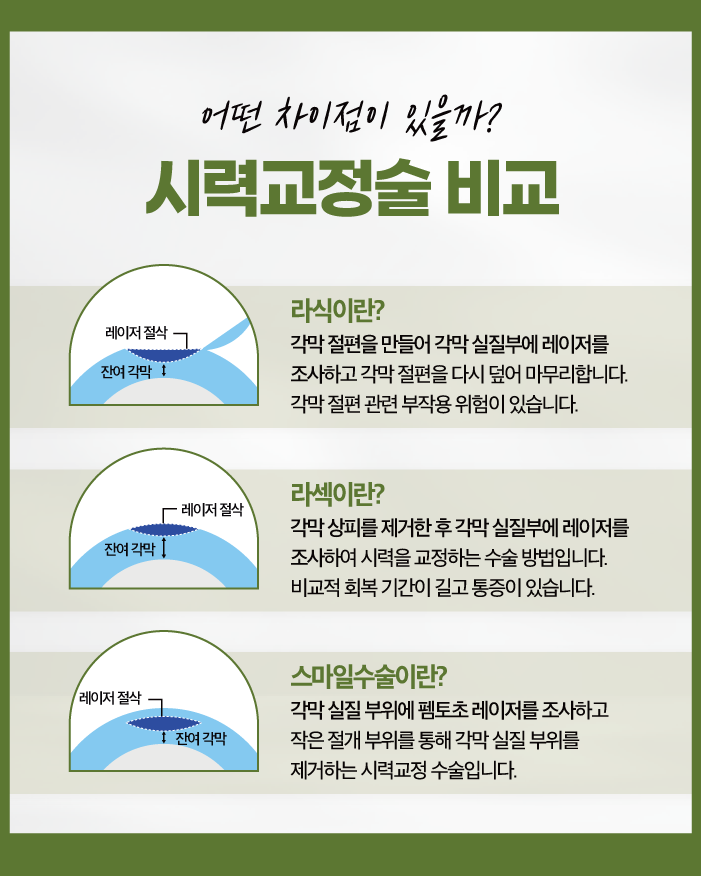
LASIK is a vision correction procedure in which a flap is created on the cornea. An excimer laser is then used to reshape the underlying corneal tissue and correct the refractive error.
After the laser treatment is completed, the corneal flap is repositioned to complete the procedure.
LASIK generally causes relatively little discomfort after surgery and is known for its rapid initial visual recovery.
However, because the procedure involves creating a corneal flap, strong external trauma may potentially cause the flap to shift or become damaged.
The creation of a flap may also affect the biomechanical stability of the cornea. Although uncommon, complications such as corneal ectasia should also be taken into consideration.

3. What Is LASEK?
LASEK is a vision correction procedure in which the corneal epithelium is removed before an excimer laser is used to reshape the cornea and correct the refractive error.
Recovery generally takes approximately 5 to 7 days, although the exact period may vary from person to person.
During the early recovery period, patients may experience discomfort, stinging, a foreign-body sensation, or increased sensitivity to light.

4. What Is Smile LASIK?
Smile LASIK is a vision correction procedure that uses a femtosecond laser to create a small, lens-shaped piece of tissue, known as a lenticule, within the corneal stroma.
The lenticule is then separated and removed through a small incision to correct the refractive error.
Smile LASIK is generally associated with relatively mild postoperative discomfort and rapid initial recovery. However, the structural condition of the cornea and the expected residual corneal thickness should be carefully evaluated before surgery.
Although uncommon, the possibility of complications such as corneal ectasia should also be considered.
During Smile LASIK, suction is used to stabilize the eye while the laser is being applied.
If the patient moves the eye significantly or if fixation is interrupted during this process, a condition known as suction loss may occur.
In addition, the suction interface used for Smile LASIK is disposable, which may contribute to the overall cost of the procedure and can be a financial consideration for some patients.
5. What Is 2-Day LASEK?
2-Day LASEK is an excimer laser-based vision correction procedure.
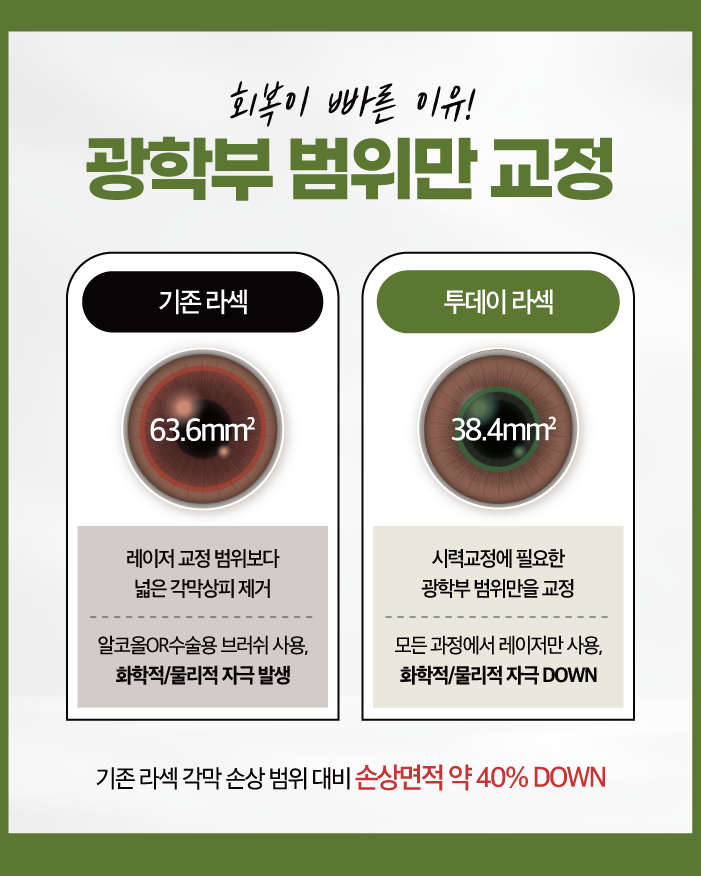
It is based on the principles of conventional LASEK and corrects refractive errors without creating a corneal flap.
The laser is precisely applied to the required optical zone to reshape the cornea and correct vision.
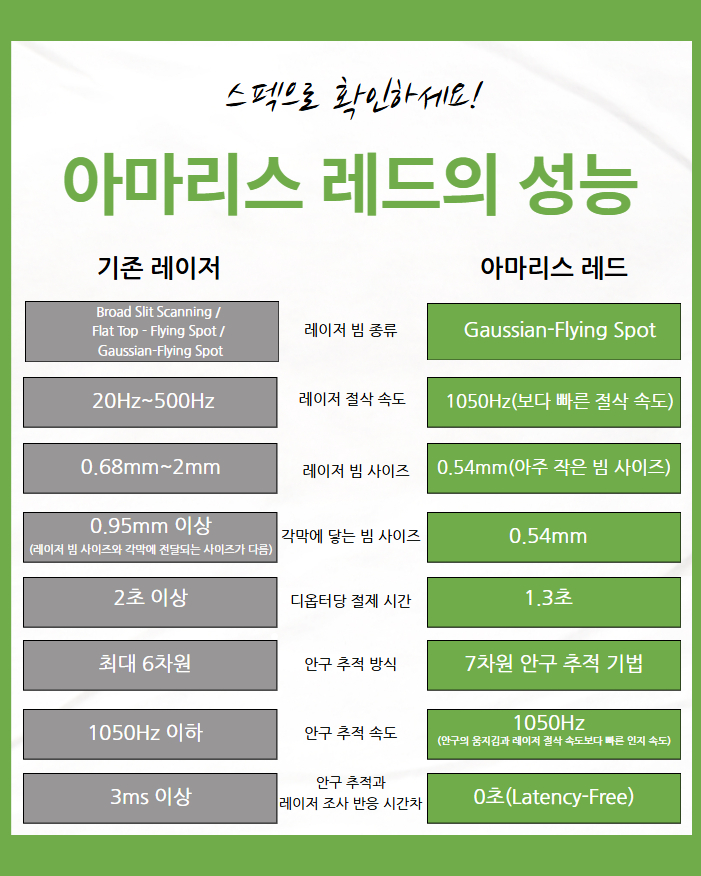
At our clinic, we use the AMARIS RED excimer laser system, which features a high laser repetition rate and a sophisticated eye-tracking system.
Compared with conventional LASEK, the epithelial removal area can be reduced by approximately 40%, and the procedure is designed to minimize mechanical stimulation during epithelial removal.
Thanks to these characteristics, many patients may be able to return to their usual daily activities approximately 2 to 3 days after surgery, depending on their individual recovery.
6. What Are the Advantages and Considerations of 2-Day LASEK?
ecause 2-Day LASEK generally requires an initial recovery period of approximately 2 to 3 days, it is important to get sufficient rest during this time, use prescribed eye drops as directed, and follow the ophthalmologist’s postoperative instructions.
Since the procedure corrects refractive errors using an excimer laser without creating a corneal flap, it avoids flap-related risks.
The AMARIS RED system used at our clinic operates at a repetition rate of up to 1,050 Hz and incorporates a 0.54 mm Gaussian flying spot.
These features allow the laser to follow the planned ablation profile with a high degree of precision.
The system also incorporates real-time eye-tracking technology, which detects subtle eye movements during the procedure and adjusts the laser position accordingly.
Therefore, while 2-Day LASEK still requires a certain period of recovery immediately after surgery, it is characterized by a flap-free approach and the use of a precise excimer laser system for vision correction.

If you are searching for an eye clinic in Deogyang-gu and comparing the cost and recovery time of Smile LASIK and 2-Day LASEK, it is important not to choose a procedure based on price alone.
Before deciding which type of vision correction surgery is appropriate for you, factors such as your corneal condition, corneal thickness, and degree of refractive error should be carefully evaluated through a comprehensive eye examination.