
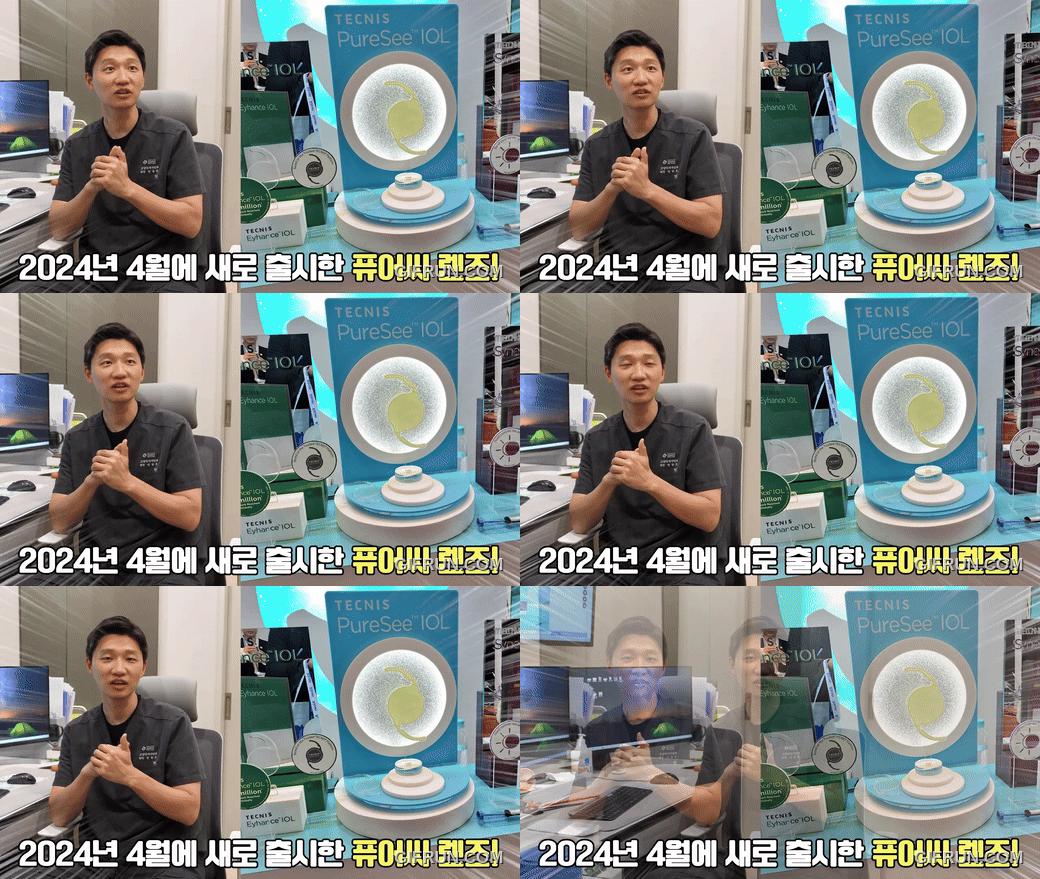
Hello,
this is Goyang Shinsegae Eye Clinic.
As we age, many people begin to notice that small print at close range becomes more difficult to read or that it takes longer for their eyes to refocus when switching between a smartphone and a computer screen.
These changes may occur due to presbyopia, a common age-related condition. When cataracts develop at the same time, additional symptoms such as blurred or cloudy vision, glare, and halos around lights may also occur.
Modern cataract surgery has evolved beyond simply removing a cloudy natural lens. Today, presbyopia correction can also be considered as part of the surgical plan.
As more patients seek greater visual comfort in daily life and reduced dependence on glasses, a variety of premium intraocular lenses (IOLs) have become available.
Among them, Vivity and PureSee have gained considerable attention as extended depth-of-focus (EDOF) intraocular lenses.
Both lenses are designed to provide a smooth range of vision from distance to intermediate ranges. However, they differ in their optical technologies and visual characteristics.
Therefore, rather than asking which lens is universally better, it is important to select an option based on the individual condition of the eyes, lifestyle, occupation, frequency of night driving, and the amount of time spent using computers and smartphones.


What Is an Intraocular Lens?
The natural crystalline lens of the eye functions much like the lens of a camera.
It refracts incoming light and focuses it precisely onto the retina, allowing us to see clearly.
As we age, however, changes in the proteins within the natural lens can cause it to lose its transparency and become cloudy. This condition is known as a cataract.
Once the natural lens has become cloudy, medication alone generally cannot restore it to its original transparency.
Therefore, when cataracts cause significant visual impairment and interfere with daily activities, the standard treatment is to surgically remove the cloudy natural lens and replace it with an artificial intraocular lens.

What Is an EDOF Lens?
EDOF stands for Extended Depth of Focus and refers to a type of intraocular lens designed to extend the range of clear vision.
Unlike conventional multifocal IOLs, which create multiple distinct focal points, EDOF lenses use optical designs that extend the depth of focus, providing a smoother transition of vision from distance to intermediate ranges.
This characteristic can be particularly useful for people who frequently use smartphones, tablets, laptops, and desktop computers in their daily lives.
EDOF lenses are also designed with visual quality in mind, including the reduction of photic phenomena such as halos and glare. For this reason, they may be considered for patients who place a high priority on nighttime visual quality, including those who frequently drive at night.

What Are the Main Advantages of EDOF Lenses?
① Continuous Vision from Distance to Intermediate Ranges
EDOF lenses extend the range of focus to provide a smoother visual transition between distance and intermediate vision.
This may provide greater visual convenience during various daily activities, such as checking the dashboard while driving, working on a computer, shopping, cooking, and performing household tasks.
② Reduced Halos and Glare
EDOF lenses are designed to reduce photic phenomena such as halos around lights and glare.
They may therefore be an option for patients who consider nighttime visual quality an important factor when choosing an intraocular lens.
③ Good Overall Quality of Vision
Their optical design aims to minimize unnecessary light loss and maintain contrast sensitivity as much as possible.
This can help provide clear vision and support visual performance in environments where distinguishing contrast and differences in brightness is important.
④ Smooth Transition Between Viewing Distances
When shifting the gaze between different distances, the transition in focus may feel relatively smooth.
This may contribute to a more natural visual experience during everyday activities, although the adaptation period and visual experience can vary from person to person.
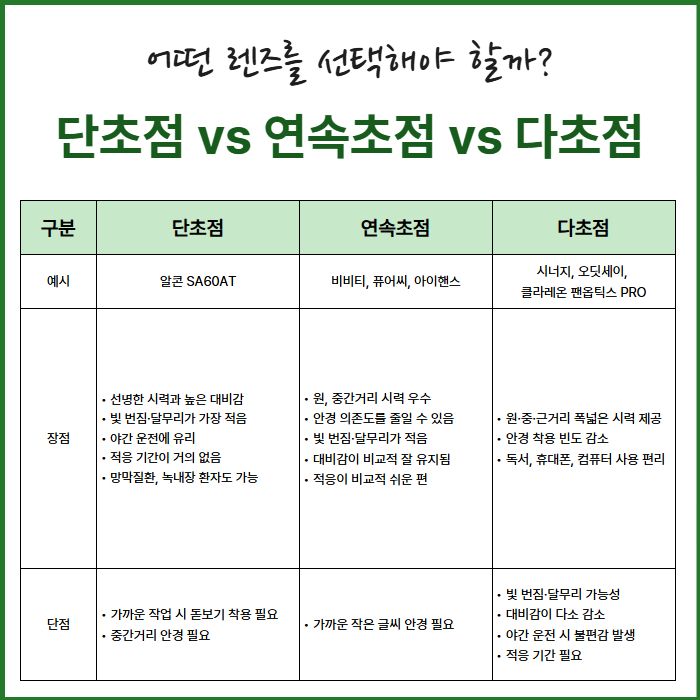
Comparison of Common EDOF and Enhanced Monofocal Lenses
1) Vivity
Vivity is a non-diffractive EDOF intraocular lens developed by Alcon.
Rather than splitting incoming light into multiple focal points, it uses wavefront-shaping technology to extend the range of focus.
Key Features
✅ Supports functional intermediate vision
✅ Designed to reduce halos and glare compared with traditional multifocal designs
✅ Designed to maintain good contrast sensitivity
✅ May be suitable for patients who place importance on nighttime visual quality
2) PureSee
PureSee is an EDOF intraocular lens developed by Johnson & Johnson.
It is designed to provide a continuous range of vision with a smooth transition between distance and intermediate viewing ranges.
Key Features
✅ Provides an extended range of vision, including intermediate distances
✅ Designed to offer continuous vision
✅ Aims to maintain stable visual quality
✅ Provides a smooth transition between viewing distances
3) Eyhance
Eyhance is an enhanced monofocal intraocular lens.
It is designed to provide improved intermediate vision compared with conventional monofocal IOLs while maintaining good distance vision.
Key Features
✅ Enhanced intermediate vision compared with conventional monofocal lenses
✅ Good distance visual acuity
✅ Optical characteristics similar to those of a monofocal lens
✅ May involve a relatively lower financial burden compared with premium multifocal IOLs

Precautions After Cataract Surgery
After cataract surgery, it is important to carefully follow your ophthalmologist’s instructions to support proper healing and reduce the risk of complications.
For approximately the first week after surgery, care should be taken to prevent water from entering the operated eye while washing the face.
Prescribed eye drops should be used regularly according to the recommended dosage and schedule.
Avoid rubbing the eye or engaging in activities that may place excessive pressure on it.
A protective eye shield should be worn for the period recommended by your ophthalmologist.
Regular postoperative follow-up appointments are also important to monitor the healing process and check for any abnormalities.
Ultimately, the most appropriate intraocular lens cannot be determined solely by comparing product features. A comprehensive evaluation of the patient’s ocular condition, including the cornea, retina, optic nerve, degree of cataract, and refractive status, should be combined with lifestyle factors and individual visual needs before selecting a lens.
Visual outcomes, adaptation, and the degree of spectacle independence may vary among individuals. Therefore, a detailed ophthalmic examination and consultation with an ophthalmologist are essential before surgery.