
Hello, this is Goyang Shinsegae Eye Clinic.
During consultations for vision correction surgery, many patients ask the same question:
“What is the difference between SMILE LASIK and 2-Day LASEK?”
This question often reflects more than a desire to compare two surgical techniques. Many patients also want to know which procedure may be more suitable for their individual eye condition.
There are several types of vision correction surgery, each with different eligibility criteria, surgical methods, and recovery processes.
Rather than assuming that one procedure is suitable for everyone, it is important to understand the characteristics of each option and choose an approach based on a comprehensive evaluation of your eyes.
In this article, we will compare SMILE LASIK and 2-Day LASEK and explain the key features of each procedure.
1. SMILE LASIK in Ilsan vs. 2-Day LASEK
When choosing vision correction surgery, it is important to consider how each procedure works and what characteristics it has.
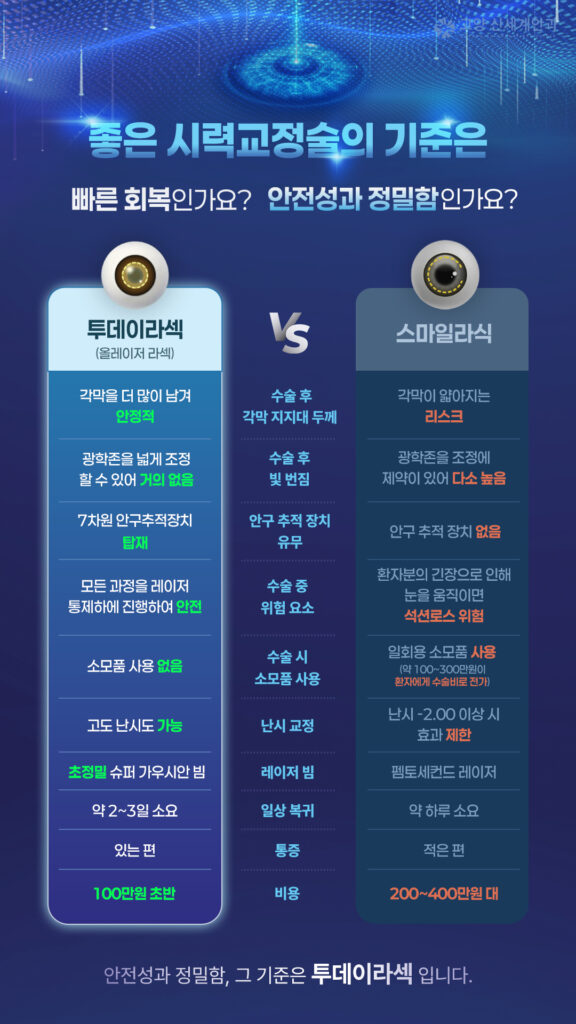
SMILE LASIK and 2-Day LASEK are widely used vision correction procedures, but they differ in both surgical technique and recovery. Understanding these differences can help patients make a more informed decision.
✔ Corneal tissue removal and night glare
With 2-Day LASEK, more of the cornea’s structural support can be preserved. This may help reduce the risk of secondary complications associated with an excessively weakened cornea, such as corneal ectasia.
SMILE LASIK, on the other hand, may leave less structural support than LASEK, which may present a relatively greater risk in certain cases.
Corneal ectasia is a complication in which the weakened cornea gradually protrudes after a LASIK or SMILE procedure.
✔ Intraoperative stability and treatment decentration
In LASIK, SMILE, and LASEK procedures, it is important to accurately treat the central optical zone of the cornea, which is generally around 6 mm in diameter.
However, patients may make small or involuntary eye movements during surgery due to tension or discomfort. For this reason, many excimer laser systems are equipped with eye-tracking technology.
The eye-tracking system monitors eye movement and adjusts the laser position so that treatment remains aligned with the intended center of the cornea.
SMILE LASIK does not use the same type of eye-tracking system during the laser treatment. Instead, the eye is stabilized using suction. If the patient moves or becomes tense, the suction may be interrupted. This is known as “suction loss.”
Some reports suggest that suction loss may occur in approximately 4 out of every 100 patients.
In 2-Day LASEK, the treatment process is controlled by the laser system. SMILE LASIK also involves the manual separation and removal of the lenticule, which may carry additional procedural risks, such as irregular tissue separation or epithelial ingrowth into the corneal stroma.
✅ Astigmatism correction
2-Day LASEK may be considered for patients with high myopia as well as higher degrees of astigmatism.
With SMILE LASIK, however, the predictability of astigmatism correction may become more limited when the degree of astigmatism exceeds −2.00 D.
✅ Night glare after surgery
With 2-Day LASEK, the optical zone may be adjusted more flexibly according to the patient’s eye condition. This may help manage the possibility of glare or halos after surgery.
SMILE LASIK offers more limited flexibility in adjusting the optical zone, which may affect the likelihood of postoperative glare in some patients.
✅ Surgical cost
The cost of 2-Day LASEK generally starts in the low KRW 1 million range, while SMILE LASIK may cost approximately KRW 2 million to KRW 4 million.
One reason SMILE LASIK is more expensive is that the suction interface used during the procedure is disposable. Depending on the laser platform, this single-use component may cost approximately KRW 1 million to KRW 3 million, and the expense is reflected in the overall surgical fee.
By comparison, 2-Day LASEK generally requires less costly disposable equipment, making the procedure relatively more economical.
Instead of spending an additional KRW 2 million on surgery, some patients may prefer to use that budget for a three-night, four-day overseas trip.
If you are considering vision correction surgery, take the time to compare the available options carefully.
Before making a decision, consider which procedure may be safer and more precise for your eyes, as well as which option is financially appropriate for you.
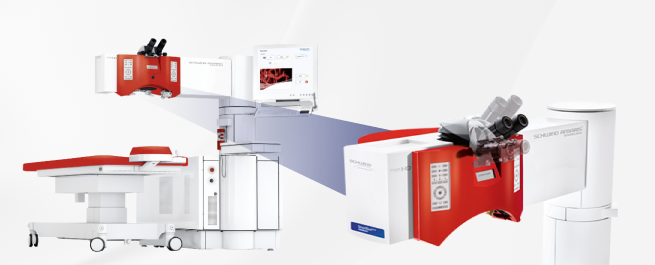
- Eye-Tracking Technology That Accounts for Eye Movement
During vision correction surgery, it is important for the laser to be delivered to the location specified in the treatment plan.
Even when the eyes appear to remain still, small movements can occur. These may include horizontal and vertical movements as well as rotational changes.
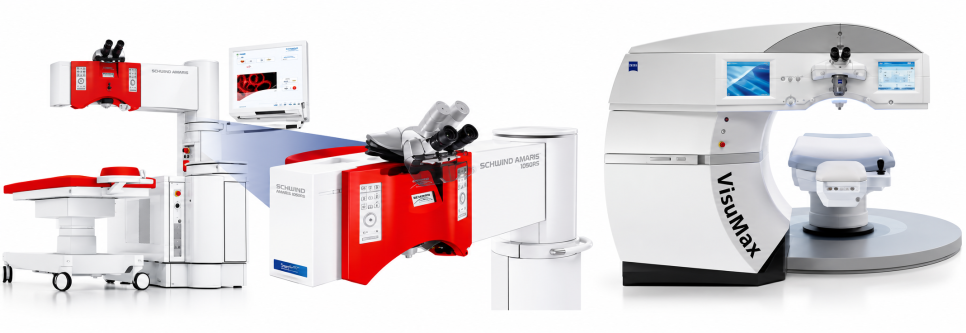
The AMARIS RED is equipped with an eye-tracking system that detects eye movement during the procedure and adjusts the laser position accordingly.
The system monitors changes in the position of the pupil and iris and uses the collected information to correct the laser delivery point.
However, the presence of an eye-tracking system alone does not determine the outcome of vision correction surgery.
A personalized treatment plan should be developed after assessing the shape and thickness of the cornea, pupil size, astigmatic axis, and the condition of the eyes at the time of examination.

- Laser Beam Size and Energy Control
When reshaping the cornea with a laser, several factors must be considered, including treatment speed, beam size, energy distribution, and the method used to prevent heat from accumulating in the tissue.
According to the manufacturer’s specifications, the AMARIS RED uses a laser beam approximately 0.54 mm in diameter.
The system applies small laser spots across multiple treatment points to create the planned corneal shape. A smaller treatment unit may allow the corneal surface to be designed and reshaped in finer detail.
Repeated laser delivery to the same area may cause heat to accumulate in the tissue. To address this, the device incorporates a thermal control function that adjusts the treatment sequence and spacing between laser pulses.
These features are technical tools used to carry out the planned treatment.
The actual treatment range and amount of corneal tissue removed may vary depending on the patient’s prescription, corneal thickness, optical zone size, and corneal topography. For this reason, the treatment plan must be based on detailed examination results.

The AMARIS RED is an excimer laser platform featuring a high treatment speed, eye-tracking technology, a small laser beam, thermal control, and an all-laser treatment process.
These functions may help carry out the planned correction, but equipment specifications alone cannot determine which procedure is most suitable for an individual patient.
When considering vision correction surgery, it is important to evaluate corneal thickness and shape, the degree of myopia and astigmatism, pupil size, dry eye symptoms, occupation, and lifestyle.
Whether SMILE LASIK or 2-Day LASEK is more appropriate depends on the results of a comprehensive eye examination and the ophthalmologist’s medical judgment.
Rather than focusing only on the advantages of each procedure, patients should also receive a thorough explanation of eligibility, the recovery process, possible risks, and postoperative precautions before making a decision.
Thank you.